Thursday, March 31, 2016

TNC: The Next Generation of Commuting in Metro Manila

Introduction

Many commuters have been getting fed up with abusive taxi drivers and undisciplined bus and jeepney drivers who back up traffic just to get more passengers. Combine this with the steadily worsening traffic situation in Metro Manila, and many commuters blow a fuse (sometimes literally) at how much time and energy they've lost just commuting.

Enter the Transport Network Company (TNC) that fill in the void that harassed commuters find themselves in. TNCs service a very specific niche of commuters who don't have or don't want to use their private vehicles yet don't want to suffer through the chaos that is Metro Manila's public transportation. Their entry has generated backlash among the more traditional transport groups, notably taxi drivers and companies, who feel threatened that commuters now have an alternative mode of transport.

While using a TNC service can be pricey, it often beats flagging down several taxis only to be refused service or to suffer through the kontrata system of drivers that do agree to the ride. TNCs are also generally safer and their growing popularity has shown that commuters have had enough, and they're expressing this through their wallets.

Here is a short list of TNCs that are currently operating or are about to operate in Metro Manila (as of March 2016):

Uber
Website: https://www.uber.com/cities/manila/

Uber was officially launched in San Francisco, California in March 2009 and has since made waves around the world as an efficient and comfortable alternative to taxis. Uber officially came to the Philippines in 2014 and comments such as "Uber was a lifesaver" are quite common, to the chagrin of local taxi operators and drivers.

Just set up the app on your smartphone and make sure you have an Internet connection and you're all set. The disadvantage is that you will need a credit card to make payments, although cash payments may be an option in the future.

Uber recently soft launched UberPOOL, a type of car pooling service.

Grab
Website: https://www.grab.com/ph/

This company started in Malaysia in 2011 and made its way to the Philippines also in 2014 (the same year as Uber's entry). Grab is actually a conglomeration of services such as GrabBike and GrabHeli but GrabTaxi is the most commonly recognized service.

Like Uber, you can set up a Grab app on your smartphone. But the difference is that they also have Grab booths in selected locations and they do accept cash payments. Furthermore, ordinary taxis can be used as a Grab vehicle.

The disadvantage is that drivers can charge higher than the rate you see on the app, especially if the destination is far and/or there is heavy traffic along the way.

u-Hop
Website: https://www.u-hop.com/

u-Hop is a Filipino start-up company that began operations late last year. However, there were some issues with the TNC application and the LTFRB halted their operations. Luckily, things worked out and u-Hop has been officially accredited since this month.

Like other TNCs on this list, they have an app which you install on your smartphone. But unlike the others, they offer a modified shuttle service where you specify a pick-up/drop-off location (which can be your house) and they pool other nearby commuters who are also subscribers into the same vehicle. This arrangement is closer to the UV Express model than the taxi model of other TNCs.

You can sign up on their website and choose to pay weekly or monthly for the service.

Wunder
Website: http://www.wunder.org/en/

Wunder is a carpooling app that started in Germany in 2013 (from the same guy who founded Airbnb). It has become increasingly popular in Europe and made its entry in the Philippines only last month.

However, the LTFRB hasn't granted a franchise yet so we don't know how well this service will take among Metro Manila's commuters.

Friday, January 8, 2016

DOTr Premium Point-to-Point Bus Service (UPDATED)

CONSOLIDATED LINKS - PREMIUM P2P BUS INFORMATION
Terminal-to-terminal only (no drop off / pick up along the way)

Alabang Town Center  to / from Greenbelt 1 (Makati)
Alabang Town Center  to / from Market! Market! (BGC)
Alabang Town Center to / from Greenhills Shopping Center
Alabang Town Center to / from Ayala Malls The 30th
Ayala Malls South Park to / from Greenbelt 5 (Makati)
ETON Centris to / from Glorietta 5 (Makati)
NAIA 3 to / from Clark Freeport Zone
Robinson's Galleria (Ortigas) to / from Glorietta 3 (Makati)
Robinson's Novaliches to / from Park Square (Makati)
SM City North EDSA to / from SM Megamall (Ortigas)
SM City North EDSA to / from Glorietta 5 (Makati)
Starmall Alabang to / from Central Mall Dasmarinas (Cavite)
Starmall Alabang to / from Starmall EDSA-Shaw
Starmall Alabang to / from Vista Mall Daang Hari (Bacoor)
Trinoma to / from Clark Freeport Zone
Trinoma to / from Glorietta 5 (Makati)
U.P. Town Center to / from Glorietta 3 (Makati)

-----------------------------------------
This is the older article

This project is a further development of the MMDA Holiday Non-Stop Bus Service which further had its origins in the Express Connect Bus System. Despite all the criticisms the DOTC is facing, they are getting some things right and this seems to be one of them.

SM North / Trinoma costs P55 while the SM Megamall route is P40. Not bad at all considering the buses are new and comfortable, there is guaranteed seating and follows a punctual regular schedule.

You can see the different schedules and destinations serviced in the infographic below (click to enlarge). The franchise for this service was extended until January 31 but let's hope this becomes more long term and doesn't suffer the same fate as the MRT.


Sources: DOTC Facebook Page, Philippine Star

Thursday, December 17, 2015

MMDA Holiday Non-Stop Bus Service

This service started on December 5 and while it costs more than your regular bus, it more than makes up for it in convenience and saved travel time. I've seen some positive feedback so I hope they can extend this service even beyond the holidays.

Here's an overview:


Source: MMDA

Monday, November 16, 2015

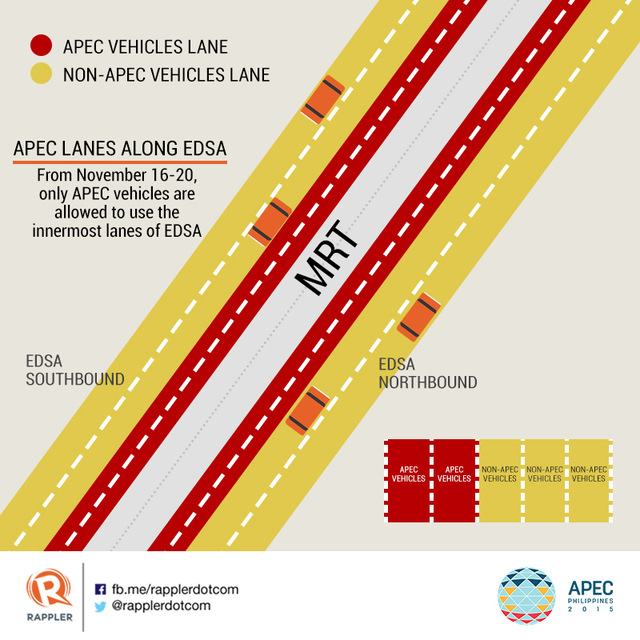
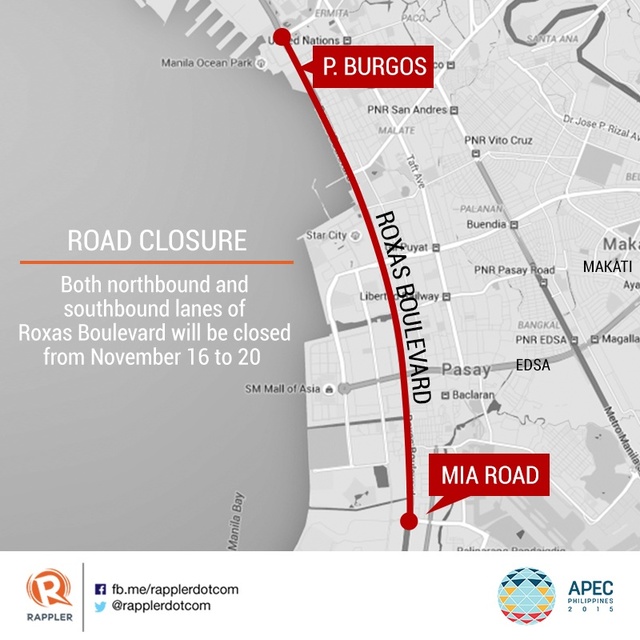
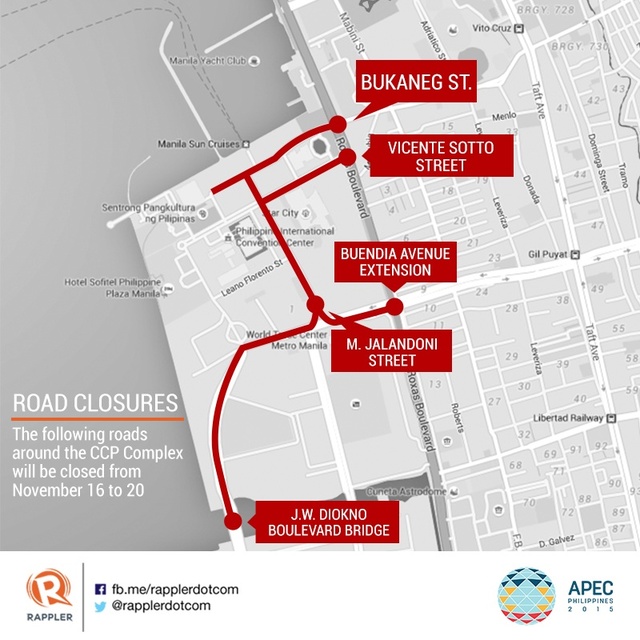
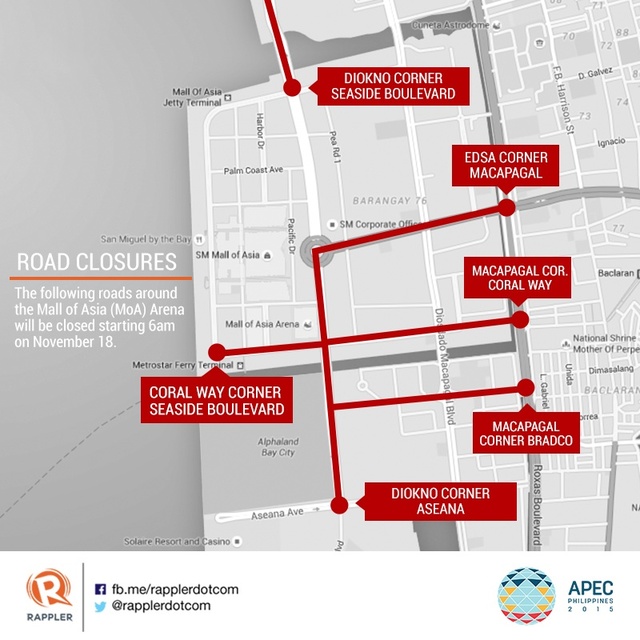
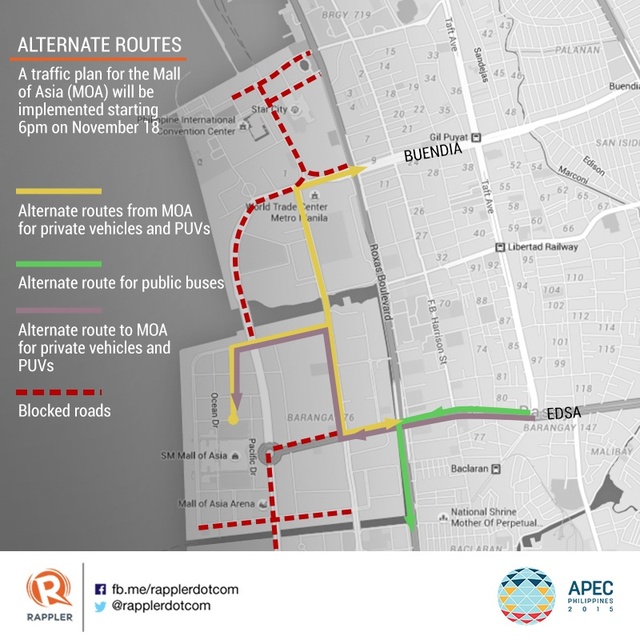
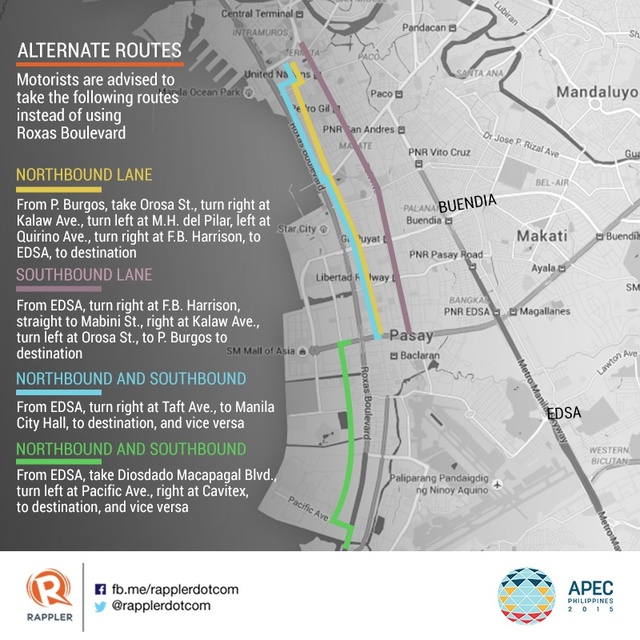
Information you need to know for APEC Week (Nov. 16 to 20, 2015)

Sources: Rappler, MMDA


Wednesday, November 4, 2015

How to Protect Yourself From "Laglag-Bala"

While air travel is not what normally comes to mind when you commute, it may still form part of your travel route. And with the sudden rise of laglag-bala (bullet planting scheme) incidents, it's better safe than sorry.

Plazo & Associates Law has compiled a helpful infographic of what you can do to protect yourself at the NAIA. If you want the complete article (including free legal advice), you can view it here.

IMPORTANT UPDATE: Travelers will no longer be detained in case bullets are found in their possession, as long as no accompanying firearms are found in the baggage. There will just be a quick check to make sure one's name is not on any terror list but otherwise you will be allowed to board your flight promptly and on schedule. This article will still be retained for future reference, in case political winds change again and this issue resurfaces.


Wednesday, June 3, 2015

Earthquake Preparedness for Commuters

The recent devastating earthquake in Nepal has brought earthquake preparedness back in vogue. Particularly, the West Valley Fault in Metro Manila has drawn a lot of special attention because just like in Nepal, the West Valley Fault is overdue for a movement.

Emergency supplies, go bags and evacuation locations are among the preparations being suggested. These are all good strategies. What lacks emphasis, however, is the peculiar situation of the commuter.

What if an earthquake strikes while you're riding the jeepney or you're walking on a sidewalk far away from home? Your emergency supplies at home would be useless to you then. Even if you owned a car, if an earthquake strikes and you're far away from your parked car, what then?

In order to partially address this information gap, the following are a few tips and strategies that a regular commuter can implement in order to make preparedness into a mindset rather than just a collection of items. This certainly won't be the bible of preparedness, but it will hopefully give you a framework upon which to start from or to add to your existing disaster preparations.

The tips are segregated based on what to do before an earthquake, during one and dealing with the aftermath. Again, the basic assumption of the following tips is that you are a commuter caught away from home the moment an earthquake hits.

BEFORE

1. Prepare a small emergency kit that you can take anywhere.

It's perfectly alright to prepare a go bag, but you can't bring it with you everywhere (just try doing the groceries while lugging it around). It would be best to have a small emergency kit that you can keep on your person, such as in your purse or belt bag. Contents can include:

- pouch-sized first aid kit (available at Mercury Drugstore)
- anti-bacterial cream to spread on cuts
- painkiller tablets
- small LED flashlight, your option of rechargeable or disposable (some tiangges sell those for as low as P10)
- thermal blanket (check True Value or some outdoor shops for these)
- 1 or 2 individually packed granola bars / trail mix
- whistle and compass

If you want to be more exotic, you can also include:

- LifeStraw personal water filter
- multi-tool or Swiss Army Knife (be careful of folding knives as you can be hassled by security guards if they find one on you while trying to enter a mall)
- Kevlar-lined workman's gloves (so that your hands don't get cut if you need to move debris with sharp edges)

2. Play the safety game.

Wherever you find yourself, try to identify the safest place you can get to from where you are if an earthquake suddenly struck. Of course, this requires you to pay more attention to your surroundings than normal, but eventually it should become second nature to you.

You want to avoid areas where heavy objects can fall on you, anywhere with a lot of wires, electrical equipment, LPG or flammable objects. Often you will need to choose the least of the bad choices, so it's your judgement call. You would also want to avoid anywhere with a lot of glass. During a strong earthquake, shattered glass can become deadly projectiles scything around the area (that's why it's not a good idea to be running around during an earthquake).

You don't have much time to react when a quake strikes, so knowing in advance where to take shelter or what you are going to do might mean all the difference to your survival.

3. Take note of the emergency evacuation areas.

There are official evacuation camps (listed below), but it also helps if you and your family also decided in advance where they would proceed in case a disaster happens while they are away from home (e.g., if it's a school day, your kid can be instructed to stay in school or proceed to a nearby relative's place).

Here are the emergency evacuations camps that have been identified:

North QuadrantNorth Quadrant Evacuation Zones
CaloocanVeterans Memorial Golf Course
ValenzuelaU.P. Diliman
Quezon City
San Juan
Mandaluyong


East QuadrantEast Quadrant Evacuation Zones
PasigLRT-2 Santolan Depot
MarikinaMarikina Boys Town
Red Cross Marikina
Ultra Pasig


West QuadrantWest Quadrant Evacuation Zones
ManilaIntramuros Golf Course
Malabon
Navotas


South QuadrantSouth Quadrant Evacuation Zones
Las PinasVillamor Air Base Golf Course
Makati
Muntinlupa
Paranaque
Pateros
Taguig
Pasay

Soure: Evacuation camps in case of a 7.2M quake in West Valley identified

DURING

If you have been playing the safety game, proceed to your pre-identified safe area if possible. There's not much you can do at this point, so the simplest strategy is "duck, cover and hold" until it's all over.

AFTER

1. Assess yourself for injuries. If you are wounded, apply first aid on yourself and apply the anti-bacterial cream to prevent infection.

2. If you can move, assess your surroundings for a safe path out. If you can't find a way out, you can use your whistle in case you hear any rescue crews nearby.

3. Decide if you will proceed home, to your pre-arranged evacuation location or to the nearest official evacuation center. Please note that a disaster of this scale can overwhelm even the most prepared first world nation, so be realistic about what relief you can expect from emergency services. Most likely you will be on your own, cut off from any communication with your loved ones (expect electricity, internet and cellphone services to be down).

You may need to scavenge for supplies and if you're too far from home, you may need to spend the night out in the rubble. Bridges may have collapsed or roads be unsafe to travel on. In that case, you need to find a passably defensible shelter where you can wait out the night (not a good idea to travel in the dark).  The thermal blanket in your emergency kit can help keep you warm through the night, especially if it's also raining.

It helps if you happen to be in a group with people you trust, since someone can alternate on guard duty during the night. A group will require more food and water to sustain though so it may complicate your logistics.

Aftershocks will also be a problem, so try to avoid structures that may topple over at the next aftershock.

LONG TERM PROGNOSIS

Realistically, if the West Valley Fault does move, the long term future of Metro Manila will be quite bleak. If the damage to infrastructure is too extensive, supplying the city's surviving inhabitants with fresh food and water will be a problem, so it may actually be safer to evacuate from Metro Manila entirely at least for a few months (if not a few years). You will need to factor this in for your long term planning.

In the meantime, stay safe!

Other sources and references:

Earthquake tips: what to do before, during, and after
PHILVOCS Earthquake Preparedness Guide (PDF)

Wednesday, May 27, 2015

How to Commute to Talipanan Beach (Puerto Galera) from Metro Manila

What's special about this place?

Although Boracay and Palawan are among the top choices for beach destinations, Puerto Galera remains popular because the beaches are still nice and clean, there are a lot of affordable resorts to choose from and it's quite easy to get there even if you're commuting. It's possible, on the spur of the moment, to spend a weekend in Puerto Galera just to relax and be back by Sunday evening recharged enough to tackle the coming week, all without breaking the bank.

Sabang is more popular with foreigners while White Beach is more popular with locals, although a lot of foreigners still go to White Beach. Among the beach fronts in the White Beach area, Talipanan Beach is the most quiet, with none of the crowds and noise associated with White Beach. There isn't much to do because of that, but if your goal is simple peace and quiet by the beach, then Talipanan Beach is for you.

One of the highlights of Talipanan is Luca's Cucina Italiana & Lodge. It offers authentic and delicious Italian cuisine with generous servings at very reasonable prices. This is where you can get Yellow Cab-sized pizzas for Greenwich prices (no kidding!).

Note: All the beaches are connected by road (even Sabang), so you could be staying in Talipanan and then go party at White Beach, for example. You just need to negotiate the rate with the tricycle (at least P120, one way).

Start Point: See below
Go to Route Index
List of PUV Terminals

1. At any of the following terminals, ride the bus going to "Batangas Port" or "Batangas Pier":

EDSA/Kamias bus terminals
Araneta Center Bus Terminal
Buendia/Taft bus terminals
Alabang South Station

Travel time to Batangas is anywhere from 2 to 3 hours, depending on which terminal you'll be coming from.

2. Get off at Batangas Port and proceed to the passenger ferry ticketing booths (there are signs, but you can easily ask around for directions).
3. Currently, only Galerian Lines goes direct to Talipanan. For other ferries, they only go as far as White Beach and from there you take a tricycle to Talipanan, but that's more expensive.
4. Buy your ticket (round-trip is cheaper) and then go to the window where you can pay the Terminal Fee.
5. You then wait for your ferry at the terminal. It's airconditioned and there are food stalls, so your wait shouldn't be uncomfortable. If you hadn't booked your accommodations in advance, you can talk to the various resort reps who will approach asking if you already have a place to stay.
6. The ferry will first make a stop at White Beach before proceeding to Talipanan (and the route is reversed when going back to Batangas Port). Ferry travel time is at least 1 hour.

Note 1: There is no pier at the beach, so wear sandals because the surf might reach your feet.

Note 2: The day before you plan to return to Batangas Port, you need to text or call Galerian Lines to find out what the ferry schedules for the next day are and to choose which ferry schedule you will use.

Reference: Puerto Galera Online Services